Despite years of research, the details of William Lee Conley Broonzy's
birth date remain problematic. He may have been born on 26 June 1893 - the
date of birth he often gave - or according to Bill's twin sister Laney,
it may have been in 1898. Laney claimed to have 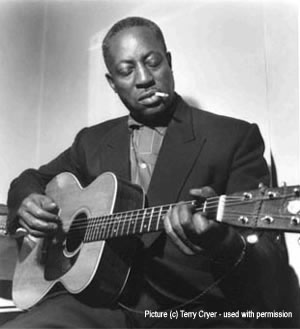 documents
to prove that. However, definitive research undertaken by Bob Reisman (see
www.amazon.co.uk or www.amazon.com search book "I Feel So Good")
has changed the picture.
documents
to prove that. However, definitive research undertaken by Bob Reisman (see
www.amazon.co.uk or www.amazon.com search book "I Feel So Good")
has changed the picture.
Bill often regaled audiences with tales of his birth on 26 June 1893 and that of his twin sister Laney and of his father's response to being told he had twins to care for. He claimed to have served in the US Army in France from 1918 - 1919 and to have been invited by a record company to travel to the Delta following a major flood in 1927: Turns out, that a good deal of this was fiction at worst and faction at best.
Robert Reisman's impeccable research suggests a birth date for Bill of 26th June 1903 (and in Jefferson County, Arkansas, not Scott Mississippi as previously suggested). Laney was not a twin at all but four years older than Bill. (She was born in 1898).
Bill spoke and sang about experiences in the US army and of his return from France to Arkansas/Mississippi. It turns out though, that the reported army experience was Bill's factional description of an amalgam of the stories told by black soldiers returning from overseas. A trip Bill claimed to have made to Mississippi in 1927 to the flooding was similarly untrue, but was a factional account into which Bill inserted himself.
Broonzy is/was not even his real name. He was born into the world with the name Lee Conly (note spelling) Bradley; and so it goes on.
Bill's father Frank Broonzy (Bradley) and his mother, Mittie Belcher had both been born into slavery and Bill was one of seventeen children. His first instrument was a violin which he learned to play with some tuition from his uncle, his mother's brother, Jerry Belcher. Bob Reisman suggests that there is little evidence that Jerry Belcher existed.
In Arkansas, the young Bill (Lee) worked as a violinist in local churches at the same time as working as a farm hand. He also worked as a country fiddler and local parties and picnics around Scott Mississippi. Between 1912 and 1917, Bill (Lee) worked as an itinerant preacher in and around Pine Bluff. It is not known why he changed his name.
Later, he worked in clubs around Little Rock. In about 1924, Big Bill moved to Chicago Illinois, where as a fiddle player he played occasional gigs with Papa Charlie Jackson. During this time he learned to play guitar and subsequently accompanied many blues singers, both in live performance and on record. Bill made his first recordings in 1927 (just named Big Bill) and the 1930 census records him as living in Chicago and (working as a labourer in a foundry) and his name was recorded as 'Willie Lee Broonsey' aged 28. He was living with his wife Annie (25) and his son Ellis (6).
Over the years, Big Bill became an accomplished performer in his own right. Through the 1930s he was a significant mover in founding the small group blues (singer, guitar, piano, bass drums) sound that typified Chicago bues.
On 23 December, 1938, Big Bill was one of the principal solo performers in the first "From Spirituals to Swing" concert held at the Carnegie Hall in New York City. In the programme for that performance, Broonzy was identified in the programme only as "Big Bill" (he did not become known as Big Bill Broonzy until much later in his career) and as Willie Broonzy. He was described as:
"...the best-selling blues singer on Vocalion's 'race' records, which is the musical trade designation for American Negro music that is so good that only the Negro people can be expected to buy it."
The programme recorded that the Carnegie Hall concert "will be his first appearance before a white audience".
Big Bill was a stand-in for Robert Johnson, who had been murdered in Mississippi in August that year. Hammond heard about Johnson's death just a week before the concert was due to take place. According to John Sebastian (1939) Big Bill bought a new pair of shoes and travelled to New York by bus for the concert. Where he travelled from is, however, left dangling. The inference of the text is that it was from Arkansas, but as noted above, by by late 1938 Bill was established as a session man and band leader, and as a solo performer in Chicago. Within weeks of the 1938 concert Bill was recording with small groups in a studio in the windy city.
In the 1938 programme, Big Bill performed (accompanied by boogie pianist Albert Ammons) "It Was Just a Dream" which had the audience rocking with laughter at the lines,
"Dreamed
I was in the White House, sittin' in the president's chair.
I dreamed he's
shaking my hand, said "Bill, I'm glad you're here".
But that was
just a dream. What a dream I had on my mind.
And when I woke up, not a chair
could I find"
According to Harry "Sweets" Edison, a Trumpeter with the Count Basie Orchestra, also in the concert, Big Bill was so overwhelmed by the audience response that he failed to move back stage as the curtain came down and got caught in front of it. Later, according to Edison) perhaps not realising he had to do a number in the second half of the concert,he was found to have left the Carnegie Hall and caught a bus home.
Regardless of the truth of that story, when a second concert was organised in 1939, on Christmas Eve, Bill was there again. This time, again with Albert Ammons, he performed two numbers: Done Got Wise, and Louise, Louise
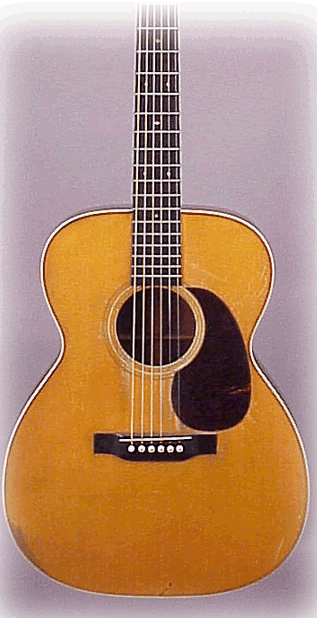
The guitar on the left is a Martin model 00028, a beautiful instrument. Bill played one of these from the 1950s to his death on 15th August 1958.